
Mission and Objectives
NFDI4Objects addresses everyone engaged with the cultural heritage of over three million years of human history, seeking to actively shape the digital transformation of this heritage and the sustainable management of research data. Our goal is to make these data available, traceable, and scientifically usable in the long term, in the spirit of Open Science.
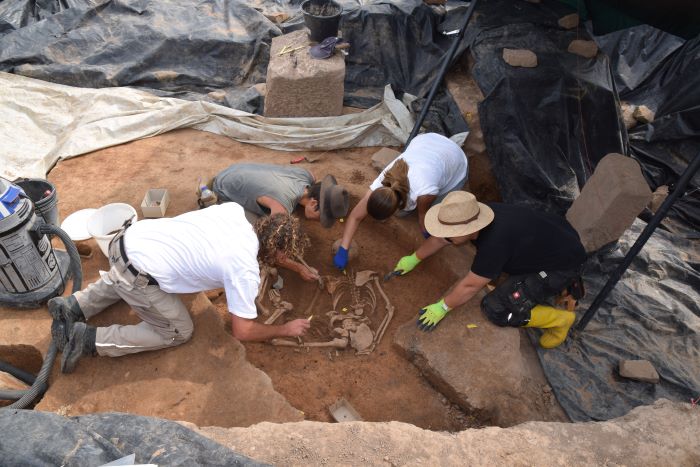
We collaborate with researchers, students, developers, and institutions involved with the material heritage of humanity—from the earliest archaeological finds to historical and museum collections. Together, we develop standards for object-related data, provide technical services, and offer practical advice and training. In doing so, we support the community in capturing, securing, publishing, and efficiently utilizing research data in accordance with the FAIR and CARE principles1.
Our work is oriented toward the entire lifecycle of an object—from initial documentation and recovery to scientific analysis, restoration, storage, publication (Linked Open Data), and long-term preservation. Equally important is the promotion of data literacy, enabling all stakeholders to independently and sustainably manage these processes. We continuously incorporate the perspectives and needs of our community.

In collaboration with our partner institutions, we are building a national research data infrastructure for the material legacy of humanity. This includes developing platforms for free software applications and digital archives, creating concepts for standardized datasets, and producing guidelines for long-term, sustainable data storage. We make the results of this work available to the community through Commons and a variety of services.
Thus, NFDI4Objects contributes to ensuring that research data on material heritage are not only preserved but can also be actively used, networked, and further developed today and in the future.
NFDI4Objects within the National Research Data Infrastructure (NFDI)
What is the NFDI?
The National Research Data Infrastructure (NFDI) is a Germany-wide initiative aimed at securing, networking, and making research data in Germany sustainably accessible. Its goal is to systematically develop scientific data from various disciplines as a common good, ensuring they are findable, accessible, interoperable, and reusable (FAIR principles).
In doing so, the NFDI creates the foundation for transparent, quality-assured, and future-oriented research, as well as a national framework for the sustainable management of research data in Germany.
The NFDI is based on a federal-state agreement from 2018. The federal government and states provide up to 90 million euros annually for this purpose from 2019 to 2028. Implementation is carried out by science-led consortia organized by the community.
Currently, 26 consortia and the joint association Base4NFDI are part of the National Research Data Infrastructure. They cover a broad spectrum of disciplines—from cultural, social, and humanities to engineering, life, and natural sciences. The selection of consortia is conducted through a science-led process coordinated by the German Research Foundation (DFG).
The Role of NFDI4Objects
NFDI4Objects is one of these consortia. It was approved in the third selection round and has been part of the NFDI funding since March 2023.
Within the NFDI, NFDI4Objects represents the material cultural and object sciences. Currently, more than 70 institutions collaborate in our consortium. We develop common standards, digital services, and infrastructures for the sustainable management of object-related research data—such as archaeological finds, historical objects, buildings, or collection holdings—and integrate these into the interdisciplinary cooperation of the NFDI.
How is the NFDI Organized?
To coordinate the overall initiative, the non-profit association Nationale Forschungsdateninfrastruktur (NFDI) e.V., based in Karlsruhe, was founded in 2020.
The funded consortia are organized as sub-divisions within the association. Institutions participating in a consortium can become members of the association. The association assumes coordinating tasks, bundles common themes, and provides an organizational framework for collaboration.
A central element of this collaboration is the so-called sections, in which representatives from various consortia work together to develop interdisciplinary standards and solutions. These currently include:
- Common Infrastructures
- Ethical, Legal, and Social Issues
- Metadata, Terminologies, and Provenance
- Training and Continuing Education
- Collaboration with Industry
NFDI4Objects also actively contributes to these sections.
Collaboration of NFDI4Objects with Other NFDI Consortia
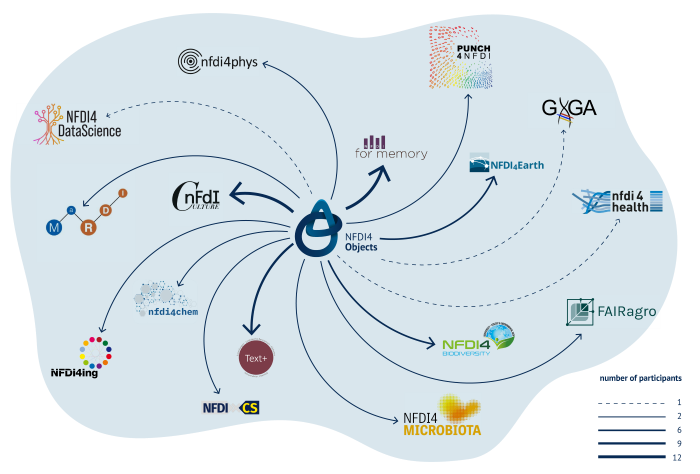
As a multidisciplinary consortium, NFDI4Objects has many points of contact with other consortia. In data collection and the resulting research data, there are numerous overlaps with natural and life science consortia within the NFDI, such as NFDI4Earth, NFDI4Biodiversity, and FAIRagro. Areas of intersection include data from landscape surveys, soil sample analysis, decoding ancient genomic data, or studies of animal bones and plant remains.
As a multidisciplinary consortium, NFDI4Objects works closely with other consortia of the National Research Data Infrastructure. Interfaces exist with both natural and life sciences as well as humanities and cultural studies initiatives, for example, in landscape surveying, soil sample analysis, genetic analysis, or the study of animal bones and plant remains.
In these areas, different disciplines encounter comparable data types and technical challenges. Exchange with consortia such as NFDI4Earth, NFDI4Biodiversity, or FAIRagro helps to develop jointly usable solutions and interdisciplinary standards.
Humanities@NFDI
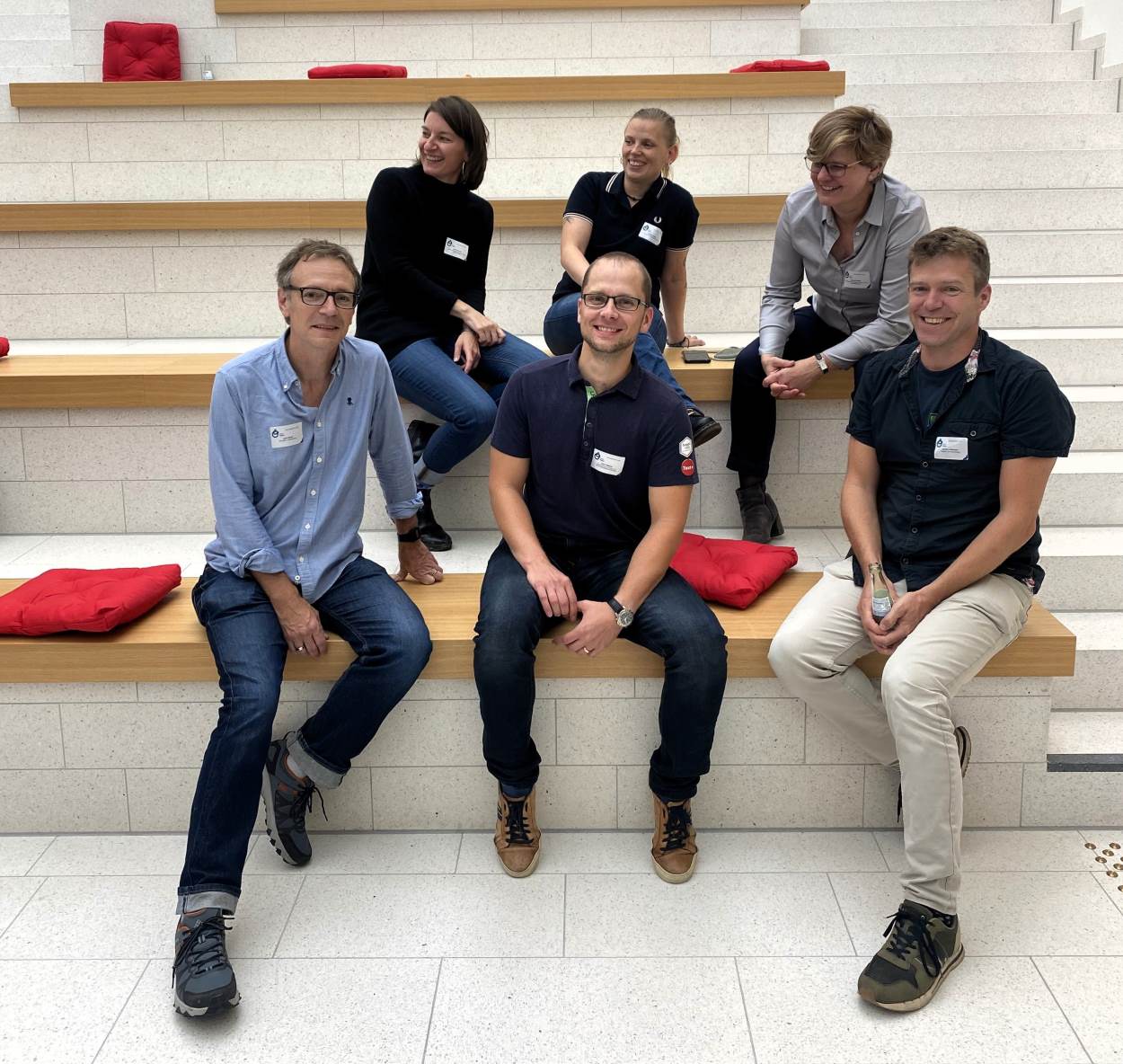
Humanities@NFDI (“Memorandum Group”) is a cooperation of the humanities and cultural studies consortia within the National Research Data Infrastructure. To best address the diverse needs of the highly differentiated humanities research landscape, the initiatives of the NFDI consortia NFDI4Culture, Text+, NFDI4Memory, and NFDI4Objects adopted a Memorandum of Understanding in 2019. This memorandum was updated in 2020. NFDI4Objects works daily as an interdisciplinary consortium in close collaboration with other NFDI consortia. Regular exchange takes place, for example here at our Community Meeting 2024.
NFDI4Objects maintains particularly close collaboration with the humanities and cultural studies consortia NFDI4Culture, NFDI4Memory, and Text+ within the framework of Humanities@NFDI.
As early as 2019, the participating consortia adopted a Memorandum of Understanding to strategically coordinate their activities and jointly promote sustainable research data management in the highly differentiated humanities and cultural studies.
Within Humanities@NFDI, workshops and training sessions are offered, common services are developed, events are organized, and interdisciplinary topics are coordinated in the sections and committees of the NFDI e.V.
Regular exchange ensures that subject-specific topics and developments are aligned at an early stage and interdisciplinary synergies are utilized. If you wish to contact the Humanities@NFDI cooperation, please write to humanities@lists.nfdi.de.
Base4NFDI
Since many disciplines have similar requirements for research data management, Base4NFDI develops cross-disciplinary basic services for the entire National Research Data Infrastructure. Existing services are adapted or further developed so that they can be used in different subject areas. This avoids parallel developments and strengthens common, interoperable solutions. For this purpose, the consortium association Base4NFDI was formed. Within this association, basic services are developed as common, interoperable solutions for the entire NFDI.
NFDI4Objects actively participates in the development and implementation of these services.
-
The FAIR and CARE principles are guidelines for the responsible management of data. FAIR stands for Findable, Accessible, Interoperable, and Reusable. CARE stands for Collective Benefit, Authority to Control, Responsibility, and Ethics. ↩