9/29/2026
Identifying Buildings: Workshop on Building Reference and Authority Data
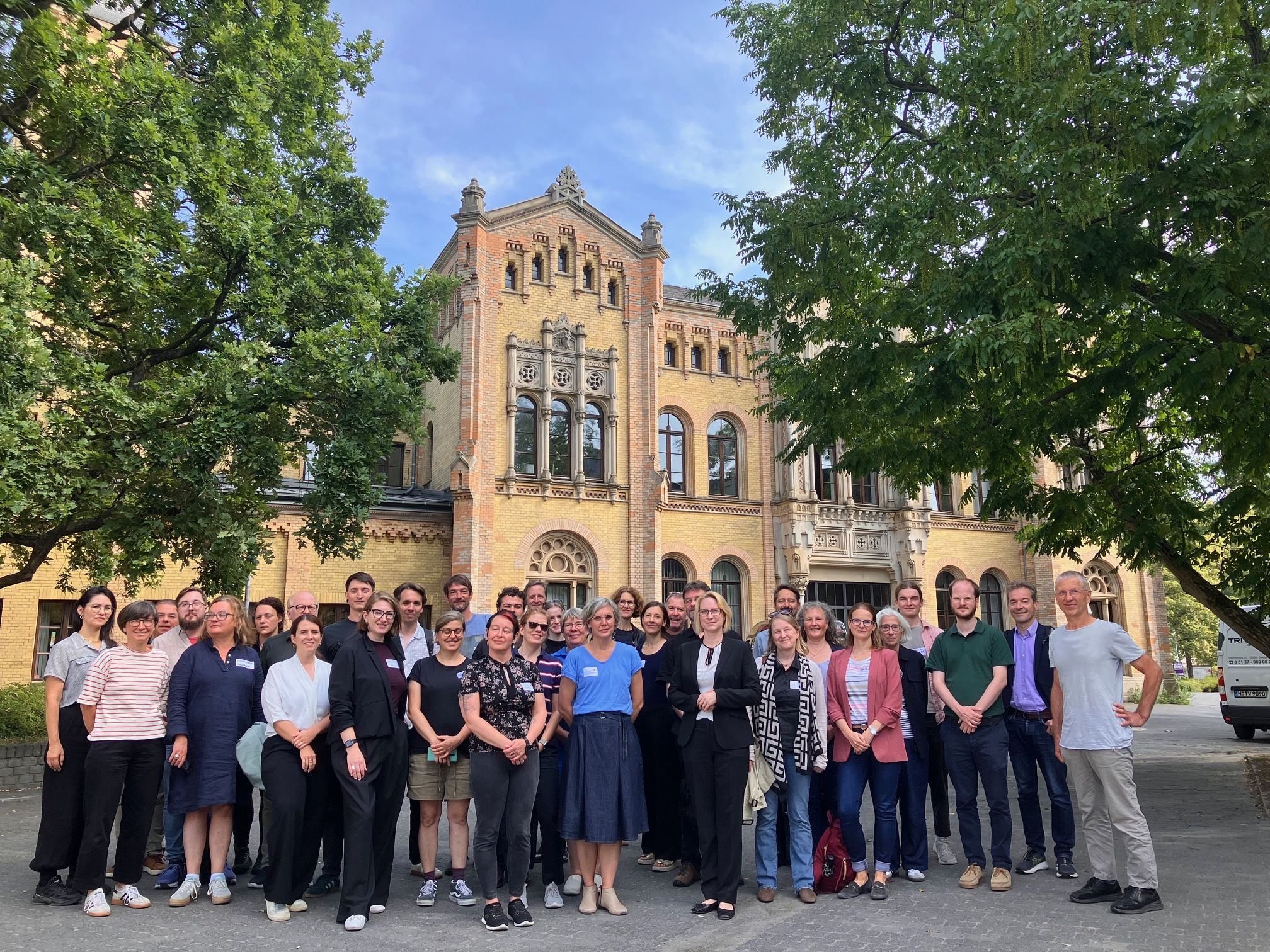
How can objects, information, and research findings be linked to buildings in research and documentation? This question was at the centre of a two-day workshop on building reference and authority data held on 26 and 27 August 2026 at the Leibniz Information Centre for Science and Technology (TIB) in Hanover. Representatives from NFDI4Culture, NFDI4Objects, and NFDI4ING met with stakeholders from collections and museums, photographic collections and image archives, research institutes, state heritage conservation offices, and the German Archaeological Institute (DAI) to discuss existing approaches, shared requirements, and possible future infrastructures.
At the beginning of the workshop, a broad range of stakeholders presented their perspectives and requirements in 12 short talks based on practical examples. Unique references to buildings are relevant not only for cataloguing architectural archives and estates, but also for archaeological building research, heritage conservation, and the systematic study of contemporary buildings and structures, such as sustainable timber buildings, bridges in need of renovation, or swimming pools designed to meet changing societal needs. Existing infrastructures such as the GND Agency for Buildings, Wikidata and Wikibase, as well as standards such as the LIDO Profile for Architecture and the CIDOC CRM-based object biography developed within NFDI4Objects, already provide important foundations. However, referencing a building as a monolithic object is not always sufficient. Buildings and their components often need to be described in detail using specialised vocabularies or linked to relevant sources. Digital tools such as DNBLab, as well as machine-assisted methods for building identification developed at the Zentralinstitut für Kunstgeschichte (ZI) in Munich, support the cataloguing process and the creation of authority data.
The workshop then explored key questions in six BarCamp sessions, including:
- Which information is relevant for authority data?
- What constitutes a building, and who determines this? For example, should persistent identifiers (PIDs) also exist for unbuilt architecture or individual building components?
- What possibilities does Wikidata offer, and is it suitable as a data hub?
- What role do vocabularies play in building authority data?
- Which organisations and research communities are relevant stakeholders for the processing and documentation of architectural archives and collections?
- How can ontology harmonisation and quality assurance be achieved, for example through the LIDO Profile for Architecture and other immovable works?
- Which tools support form-based data entry and data visualisation, for example in Wikibase?
On the second day of the workshop, participants discussed concrete measures and roadmaps that will be developed further in the coming months. It became clear that questions of building identification connect specialist communities from engineering, architecture, cultural heritage, archaeology, heritage conservation, and collection documentation. They are also highly relevant to broader societal objectives, including achieving a climate-neutral building stock, improving the sustainability of infrastructure, and safeguarding cultural heritage.
Existing infrastructures such as the GND and Wikidata need to be expanded and more closely interconnected. A low-threshold, PID-based referencing mechanism should complement existing authority data services in cases where a building needs to be uniquely addressable for research purposes, but the requirements for creating a comprehensive authority record are not yet, or cannot yet be, fulfilled.
The relevance of these infrastructural challenges extends beyond the research communities represented by the organising NFDI consortia. Specialist public authorities and collections in particular were identified as important stakeholders. The intensive discussions and jointly outlined strategies provide a strong basis for the next steps. A follow-up event is already planned for early 2027.